Leecoll Density Gradient Media
Product Code LCS
Choose Your Product
For R&D use only
Product Details
Product Information
| Physical State | Liquid |
|---|---|
| Ingredients | Silica gel particle media modified with a polyvinylpyrrolidone (PVP) coating |
| CAS | 65455‑52‑9 |
| Density (20 ℃, g/mL) | 1.125-1.135 |
| Viscosity (cP) | <15 |
| Osmolality (mOsmol/kg) | <25 |
| Conductivity (mS/m) | <100 |
| pH | 8.5-9.5 |
| Color | Colourless to slightly yellow |
Product Description
Leecoll is a fully validated density gradient centrifugation medium for cells, viruses, and subcellular particles.
Based on well-established density gradient centrifugation theory, this product enables gentle, rapid, and efficient separation of various cell types, viruses, and subcellular fractions within the density range of 1.0–1.3 g/mL. It is suitable for separation of most biological particles with a sedimentation coefficient greater than 60S.
The core component of this product is a PVP-coated silica particle medium with a particle size of 15–30 nm and a free PVP content of only 1%–2%, featuring a scientifically formulated and stable composition. The silica particles have inherent particle size heterogeneity, which allows differential rate sedimentation during centrifugation to spontaneously form a continuous, isotonic density gradient. The experimental operation is convenient and flexible: density gradients can be rapidly prepared using a gradient mixer or high-speed centrifuge. Alternatively, samples can be pre-mixed with the medium to perform separation within the in-situ formed gradient, achieving gradient formation and sample separation in one single step. Satisfactory separation results can be obtained in a single run, greatly simplifying workflows and improving experimental efficiency.
Key Advantages
• Excellent activity preservation: low viscosity, non-toxic under isotonic conditions, high biocompatibility. It does not penetrate biological membranes or adhere to cells, and can stably maintain the density of biological particles as well as sample viability.
• Convenient and efficient usage: Continuous density gradient forms spontaneously upon centrifugation; compatible with large-volume sample processing, simple operation, and short assay duration.
• Wide compatibility: Compatible with multiple common buffers and culture media, allowing flexible preparation of density gradients ranging from 1.0 to 1.3 g/mL.
• Stable and reliable performance: Optimized formulation with strict quality control and stable physicochemical properties. The stock solution can be autoclaved repeatedly and delivers favorable assay reproducibility.
Applications
Designed for processing biological samples such as blood and tissues, it efficiently separates, purifies, and enriches cells, bacteria, viruses, organelles, and various subcellular components. It can also effectively discriminate intact viable cells from damaged cells and cell debris.
Transportation and Storage
- Transportation at Ambient Temperature
- The product can be stored at 4–30 °C. Refrigerated storage at 4–8 °C is preferred.
- The unopened product has a shelf life of up to 5 years when stored at ambient temperature. After opening, storage at 4–8 °C is recommended. For optimal stability, the product should be stored at 4–8 °C regardless of whether it has been opened.
- Long-term storage at −20 °C is not recommended. If stored at −20 °C for a short period, the storage duration should not exceed 6 months. After freezing and thawing, the product should be thoroughly mixed before use.
- During storage, maintain the system pH within 5.5–10 and avoid contact between the reagent and divalent cations.
Notice
1. To ensure the safety and health of operators, laboratory coats and disposable gloves must be worn throughout the entire experimental procedure.
2. Certain technical information provided with this product is intended for customer reference, academic communication, and scientific research purposes only. Our company does not warrant the absolute authority or completeness of the information provided.
3. This product is for research use only. It is strictly prohibited for use in clinical diagnosis, treatment, food, pharmaceuticals, or any other applications involving human use. Do not store this product in ordinary residential premises.
Technical Data
Data
Isolation of Immune Cells from Mouse Whole Blood
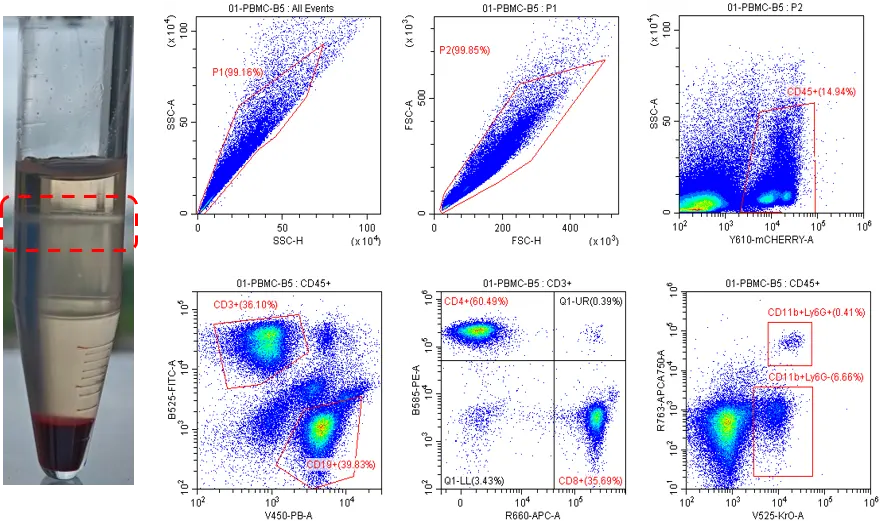
• Efficient separation of immune cells from red blood cells in mouse whole blood. Flow cytometric analysis demonstrated that the isolated cells contain multiple immune cell subsets
Isolation of Mouse Hepatic Parenchymal Cells

• Efficient isolation of mouse hepatic parenchymal cells. After overnight culture in complete medium, the cells adhered and spread normally and exhibited good growth.
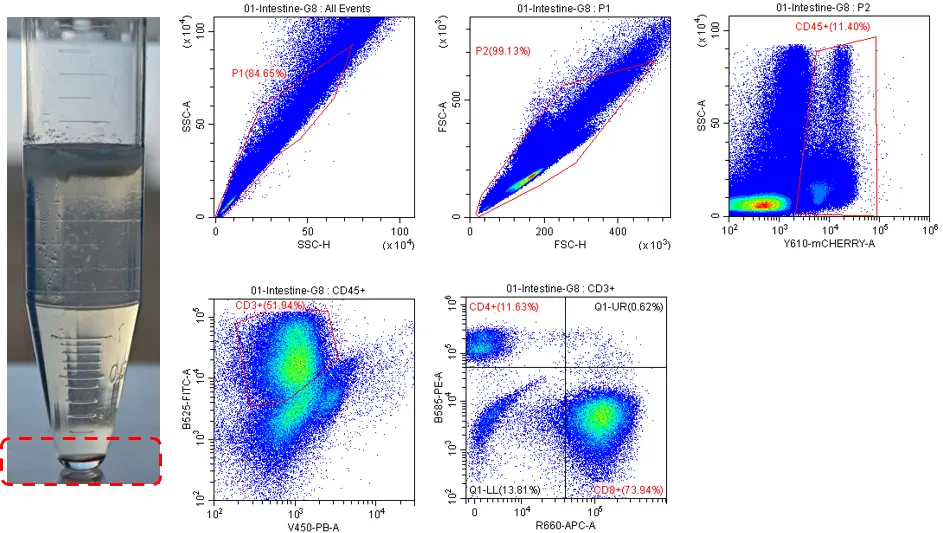
Isolation of Intestinal Epithelial Immune Cells from Mouse
Efficient isolation of mouse intestinal epithelial immune cells. Flow cytometric analysis of the harvested cells revealed that the CD45⁺ population displayed a typical distribution with a high proportion of CD3⁺CD8⁺ cells.