
Product Information
Item | Specification |
|---|---|
Product Description | Synthetic drop-in substitute for Digitonin • glyco-diosgenin |
Molecular Formula | C56H92O25 |
CAS Number | 1402423-29-3 |
Formula Weight | 1165.31 |
CMC (H₂O) | ~ 18 μM (0.0021%) |
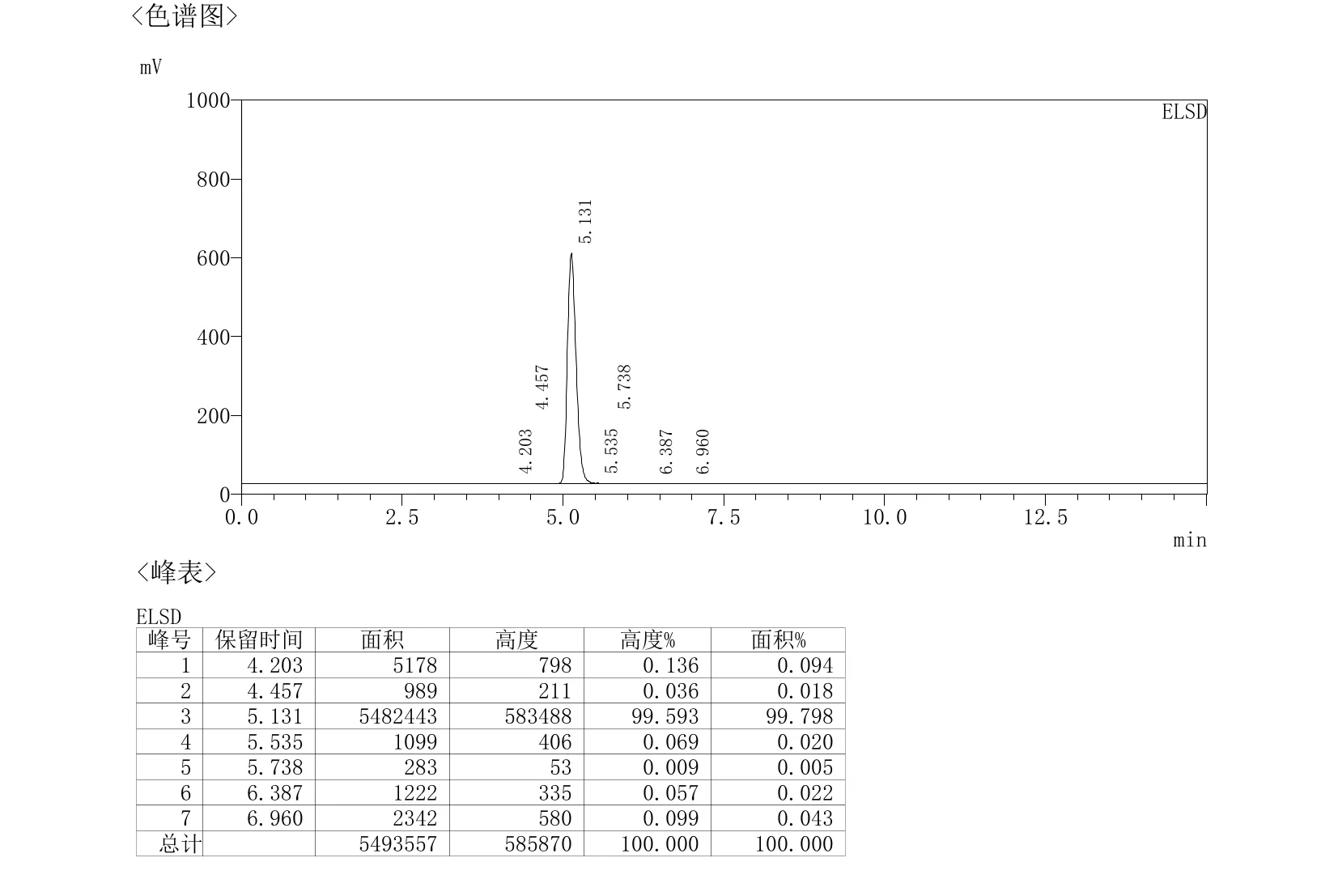
Purity | ≥ 99 (by HPLC analysis) |
pH | 5-8 (1% solution in water) |
Solubility | ≥ 5 % (in water at 20°C) |
Conductance | < 100 μS (5% solution in water) |
Product Description
GDN (glyco-diosgenin) is a synthetic non-ionic detergent composed of a rigid sterol-based (diosgenin) hydrophobic tail and a di-maltose hydrophilic head group. It is a synthetic drop-in substitute for Digitonin. Unlike natural Digitonin extracted from Digitalis purpurea, GDN is produced synthetically, free of toxic byproducts such as digitoxin and digoxin, with no batch-to-batch variation, a lower critical micelle concentration (CMC), and superior water solubility.
Key Advantages
A Fully Synthetic Alternative to Digitonin: Manufactured using a fully synthetic process that offers excellent batch-to-batch consistency. Free from common Digitonin-related impurities, such as digitoxin and digoxin, with good solution stability and high reproducibility.
An Ideal Detergent for Membrane Protein Structural Studies: Its mild properties help preserve native protein–lipid interactions and fragile multiprotein complexes. With an extremely low CMC (approximately 18 µM; 0.0021%), GDN forms small protein–detergent complexes, making it particularly suitable for membrane protein solubilization, purification, and cryo-EM structural analysis.
High Water Solubility for Convenient Use: Water solubility of ≥10% (w/v) at 20°C, higher than that of Digitonin, allowing high-concentration stock solutions to be prepared directly.
High Stability: Forms stable micellar systems that can help extend the storage time of membrane proteins in solution.
Broad Applicability: Validated in established research applications, GDN has been successfully used in studies of membrane proteins, including GPCRs and ion channels, demonstrating excellent performance.
Applications
This product meets a variety of membrane protein research needs, including but not limited to:
Solubilization, extraction, and purification of membrane proteins (direct substitute for Digitonin)
Single-particle cryo-EM sample preparation (GPCRs, ion channels, transporters, etc.)
Lipidic cubic phase (in meso / LCP) crystallization
Maintenance of membrane protein solution stability and functional studiesIn Vitro Assays: Used for in vitro bioluminescence detection and quantitative determination of luciferase expression
Transportation and Storage
Store protected from light and moisture; recommended storage temperature: -20 C.
Ship at ambient temperature.
Stable as a powder; aliquot stock solutions and store at -20 C. Avoid repeated freeze-thaw cycles.
Notice
To ensure the safety and health of operators, laboratory coats and disposable gloves must be worn throughout the entire experimental procedure.
Certain technical information provided with this product is intended for customer reference, academic communication, and scientific research purposes only. Our company does not warrant the absolute authority or completeness of the information provided.
This product is for research use only. It is strictly prohibited for use in clinical diagnosis, treatment, food, pharmaceuticals, or any other applications involving human use. Do not store this product in ordinary residential premises.
Technical Data
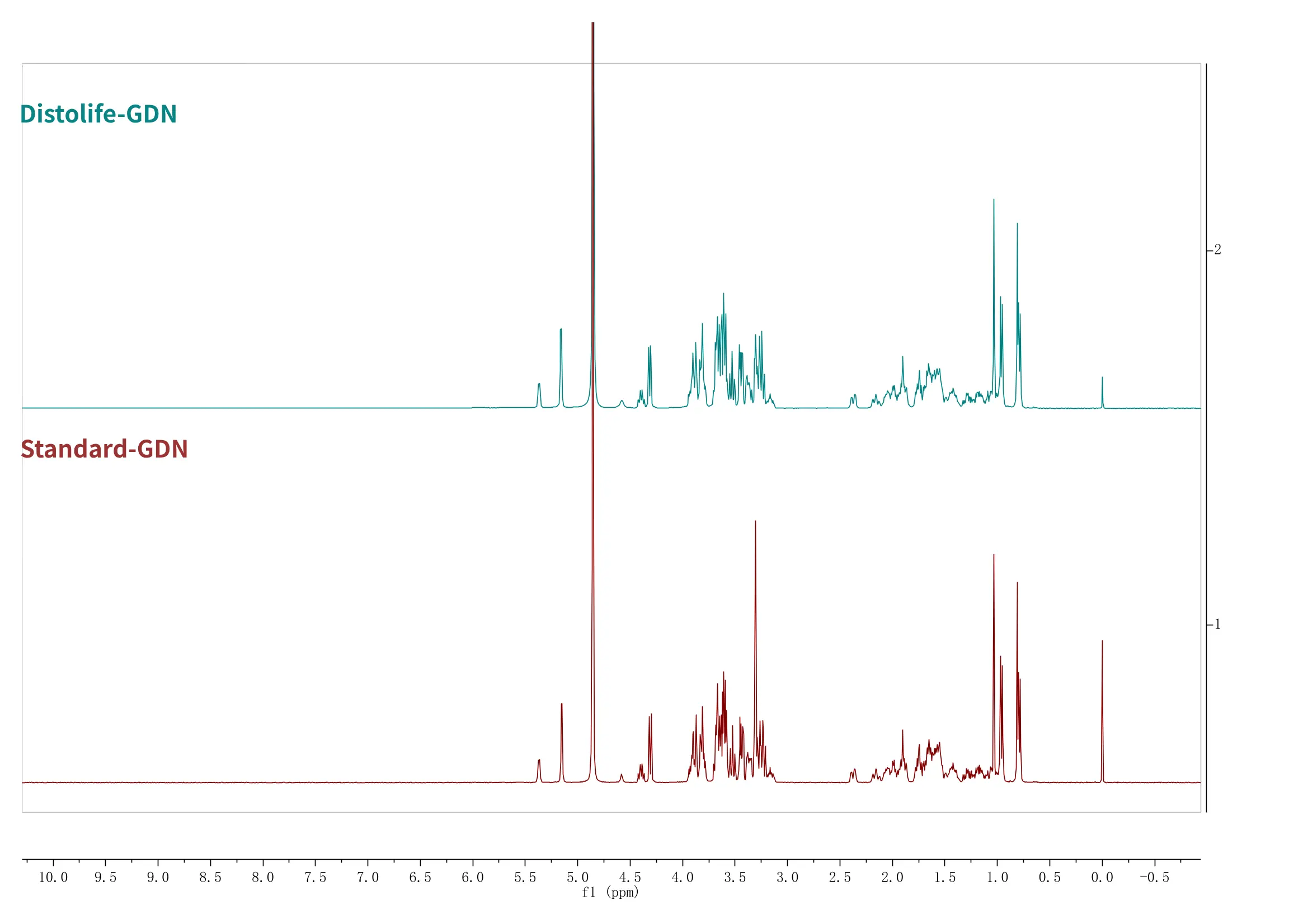
NMR
HPLC
Purification of the GPCR Adenosine A2A Receptor (A2AR) Using Tisyn’s In-House-Developed GDN
1) SEC-HPLC Chromatogram Analysis
The following SEC-HPLC chromatograms show A2AR protein extracted and purified using Tisyn’s in-house-developed GDN detergent.
The left panel shows that both the peak area and peak height of Tisyn’s product are greater than those of the commercially available comparator, indicating a slightly higher protein yield. In the right panel, after normalization, the two products exhibit similar peak profiles, while Tisyn’s in-house-developed GDN shows a higher monomer fraction than the reference product, suggesting better conformational stability.
Overall, Distolife’s GDN demonstrates excellent performance in maintaining the native conformation of A2AR, reducing protein aggregation, and improving protein yield.
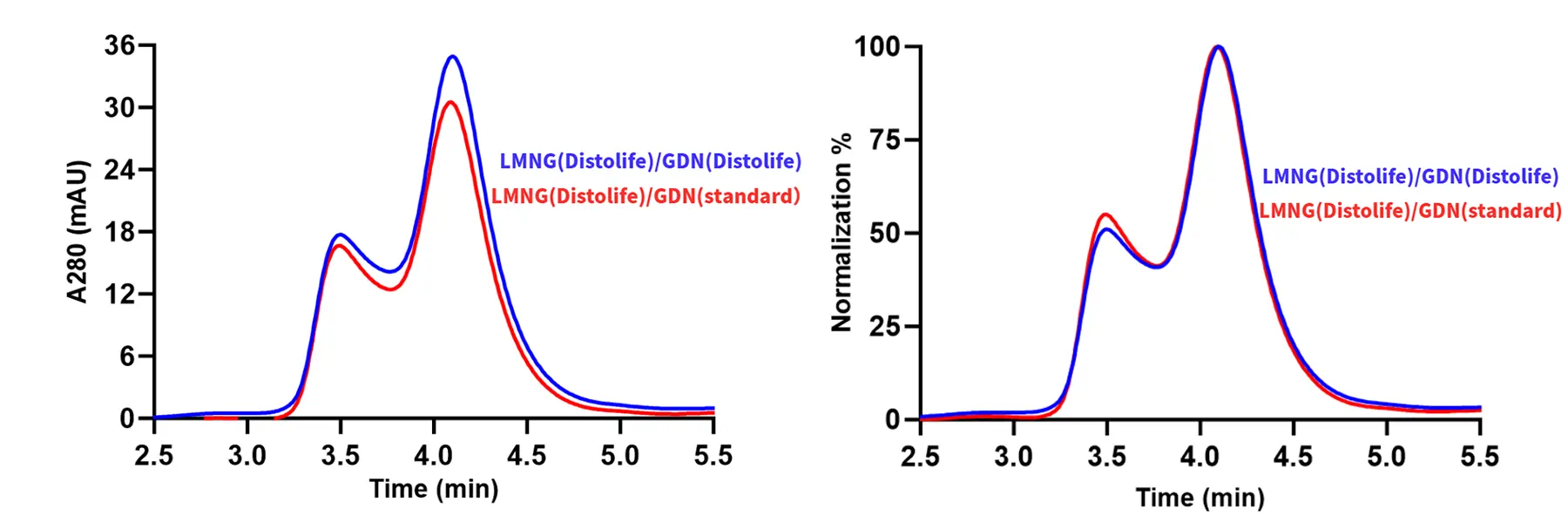
Left: A280 chromatogram; right: normalized chromatogram.
2) SDS-PAGE
SDS-PAGE analysis of both samples revealed a relatively single, well-defined target protein band, with a molecular weight consistent with the theoretical value of the GPCR receptor.
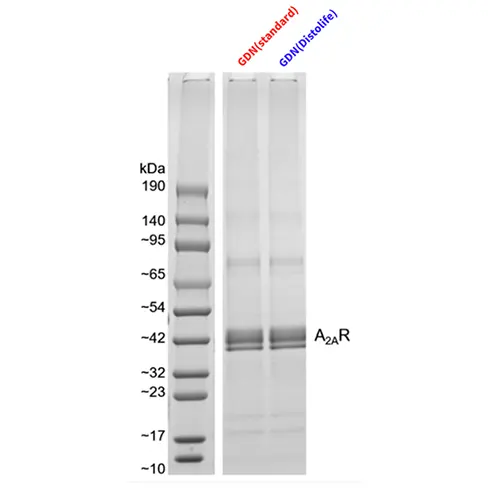
The results demonstrate that Tisyn’s in-house-developed GDN has been successfully applied to the purification and preliminary characterization of A2AR, a representative GPCR. It exhibits excellent performance in protein yield and conformational stability, demonstrating the potential of this GDN-based detergent system to support GPCR research.