
Published on: 7/22/2026
July 2026: A landmark breakthrough in *Science* | AI-driven de novo design of WRAP soluble proteins, rewriting the fundamental paradigm for membrane protein extraction and purification

Membrane proteins account for approximately 30% of the proteins encoded by the human genome and serve as direct targets for more than 60% of marketed drugs. Core targets—including G protein-coupled receptors (GPCRs), ion channels, transporters, and outer membrane pore proteins—have consistently been at the heart of research in structural biology, innovative drug target discovery, and CRO-based in vitro protein preparation. However, for a long time, the dissolution of hydrophobic transmembrane regions and their conformational stability have represented the most significant technical bottleneck in the resolution of membrane proteins: traditional methodologies heavily rely on chemical detergents such as DDM, LMNG, and OG to solubilize the lipid bilayer of the cell membrane; these approaches not only tend to disrupt the native quaternary structure of membrane proteins and dissociate key endogenous binding lipids, but can also induce a series of issues, including protein aggregation, loss of activity, and severe orientation bias in cryo-electron microscopy particles. Although subsequent developments in MSP nanodiscs and SMA/SMALP polymer-based detergent-free systems have significantly improved stability, they still face limitations such as low reconstitution efficiency, poor batch-to-batch reproducibility, and difficulties in capturing ultra-large complexes during assembly. On July 2, 2026, the David Baker Group at the University of Washington published a landmark original study in *Science*, leveraging the top-tier protein AI model RFdiffusion to de novo design an amphiphilic water-soluble protein, WRAP (Water-soluble RFdiffused Amphipathic Protein). This work establishes a novel membrane protein solubilization and purification approach that is entirely independent of any chemical detergents, does not require in vitro lipid reconstitution, and can be achieved through gene co-expression—providing a disruptive solution for the structural determination of membrane proteins that are difficult to express, prone to inactivation, or highly sensitive to lipids via cryo-electron microscopy.

Membrane proteins account for approximately 30% of the proteins encoded by the human genome and serve as direct targets for more than 60% of marketed drugs. Core targets—including G protein-coupled receptors (GPCRs), ion channels, transporters, and outer membrane pore proteins—have consistently been at the heart of research in structural biology, innovative drug target discovery, and CRO-based in vitro protein preparation. However, for a long time, the dissolution of hydrophobic transmembrane regions and their conformational stability have represented the most significant technical bottleneck in the resolution of membrane proteins: traditional methodologies heavily rely on chemical detergents such as DDM, LMNG, and OG to solubilize the lipid bilayer of the cell membrane; these approaches not only tend to disrupt the native quaternary structure of membrane proteins and dissociate key endogenous binding lipids, but can also induce a series of issues, including protein aggregation, loss of activity, and severe orientation bias in cryo-electron microscopy particles. Although subsequent developments in MSP nanodiscs and SMA/SMALP polymer-based detergent-free systems have significantly improved stability, they still face limitations such as low reconstitution efficiency, poor batch-to-batch reproducibility, and difficulties in capturing ultra-large complexes during assembly.
On July 2, 2026, the David Baker Group at the University of Washington published a landmark original study in *Science*, leveraging the top-tier protein AI model RFdiffusion to de novo design an amphiphilic water-soluble protein, WRAP (Water-soluble RFdiffused Amphipathic Protein). This work establishes a novel membrane protein solubilization and purification approach that is entirely independent of any chemical detergents, does not require in vitro lipid reconstitution, and can be achieved through gene co-expression—providing a disruptive solution for the structural determination of membrane proteins that are difficult to express, prone to inactivation, or highly sensitive to lipids via cryo-electron microscopy.
I. Technical Underlying Logic: What is WRAP AI's artificial design of membrane-encapsulated proteins?
1. WRAP Naming and Design Kernel
WRAP stands for "Water-soluble RFdiffusion Amphipathic Protein"; its literal translation is "a water-soluble amphiphilic encapsulating protein designed based on the RFdiffusion diffusion model." The entire design was fully implemented using the RFdiffusion deep learning-based protein generation framework independently developed by the Baker team, with a particularly ingenious core design approach:
(1) For target membrane proteins exposed in aqueous environments—specifically their hydrophobic transmembrane helices and β-sheet hydrophobic outer surfaces—AI accurately calculates the spatial distribution, curvature magnitude, and oligomerization interface of all hydrophobic residues;
(2) Automatically generates a spherical closed artificial protein shell, with hydrophobic amino acids enriched on the inner surface and entirely composed of hydrophilic charged amino acids on the outer surface;
(3) The WRAP protein spontaneously encapsulates the hydrophobic transmembrane domain of membrane proteins via hydrophobic interactions, with its external hydrophilic scaffold directly conferring ultra-high solubility to the entire complex in aqueous solutions, thereby perfectly mimicking the protective environment of the cell membrane's phospholipid bilayer.
2. The most fundamental difference from traditional methods
Preparation System | Core Principles | Whether detergents are used | Whether endogenous lipids are retained | Operational Complexity | Applicable protein types |
|---|---|---|---|---|---|
DDM/LMNG Dispersing Detergent Micelles | Chemical surfactants encapsulating hydrophobic regions | yes | Severe loss | secondary | Highly stable monomeric membrane proteins |
MSP Lipid Nanoparticles | Stabilin protein + exogenous phospholipid in vitro reconstitution | Micro-detergent auxiliary | Exogenous artificial lipids | High-throughput (multi-step reconstruction, lipid screening) | Small and medium-sized single-pass transmembrane or seven-pass transmembrane receptors |
SMA/SMALP polymers | Amphiphilic polymer-based in situ capture of membrane proteins–lipid particles | deny | Complete endogenous lipids | Medium to High | GPCRs, Ion Channels |
AI WRAP: Artificial Protein Wrapping | Gene-encoded proteins spontaneously bind to hydrophobic surfaces | Not at all necessary. | Can co-retain membrane-associated lipids | Low (intracellular co-expression yields single-step production) | Multiple transmembrane α-helices, β-barrel outer membrane proteins, and oligomeric complexes |
II. Core validation data for Science papers: structural resolution and conformational fidelity are at optimal levels.
Using a de novo protein shell to replace detergents in WRAP: OmpA/Tp/GlpG/miniCXCR4 demonstrates "solubility + thermostability + complete retention of ligand-binding activity/enzymatic activity/epitope"; the 2.95 Å RMSD for MspA_SBD (0.5–0.7 Å) confirms that "high-resolution structural determination in aqueous solution is feasible."
2.1 Method Kernel
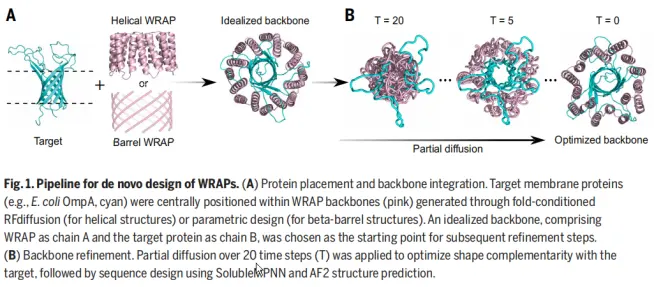
RFdiffusion generates hollow helical/β-bucket WRAP scaffolds → Partial diffusion (T=15–20) to anchor the hydrophobic regions of membrane proteins → Soluble MPNN is used for target sequence-based WRAP sequence design → AF2 filtering → GS linker-mediated gene fusion; the soluble protein is expressed directly in the cytoplasm of E. coli without altering the native sequence of the membrane protein or using detergents.
2.2 Solubilization + Stability
drone | type | Soluble yield | Thermal stability (CD/DSF) | Key auxiliary verification |
|---|---|---|---|---|
OmpA | β-bucket monomer | 5/6 helical WRAP and 1/6 β-sheet WRAP are soluble. | Does not melt at 95°C | SEC monomeric peak; ELISA epitope retention; native MS reveals core disaccharide structure |
Tp OMPs (TP0126/0479/0698/0733) | AF2 predicts β-sheets | 15–30% design solubility | Fully folded | Infection-specific rabbit serum ELISA test was positive; Apo-AI control failed. |
GlpG | Multi-pass transmembrane helicase | Soluble in water (3/6) | 95 °C (deionized detergent state: T<sub>m</sub> = 77 °C) | The FP-TAMRA probe labels wild-type and mutant forms; no labeling is observed for mutants. |
miniCXCR4 | Truncated GPCR | 2/46 Soluble | Stable at 95°C | BLI assay for CXCL12 KD: 390 ± 90 nM; native MS combined with plerixafor at a 1:1 ratio |
2.3 High-resolution structural closed-loop
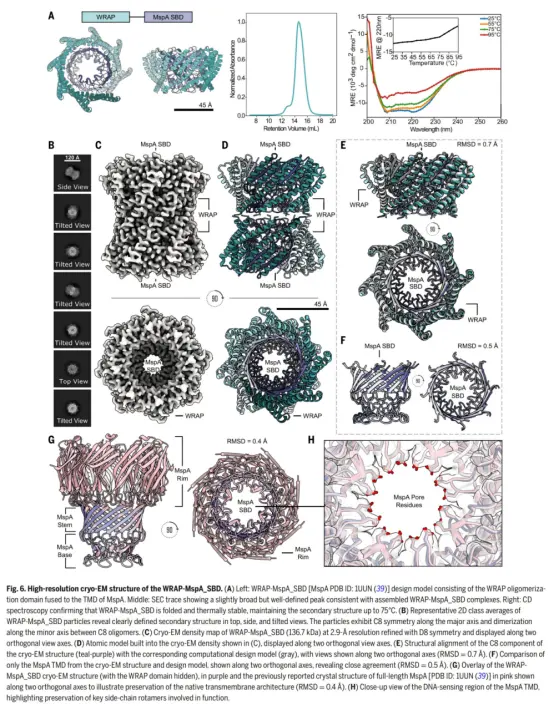
Target: MspA_SBD (mycobacterial porin transmembrane stem + pore domain; C8 symmetric; 136.7 kDa).
8 designs contain one highly expressed soluble component, which does not melt at 75 °C;
Cryo-EM (multi-angle data collection): D8 symmetry, 2.95 Å; C1 symmetry, 3.34 Å;
Comparison with the design model: C8 component RMSD = 0.7 Å; for only the MspA_SBD domain, RMSD = 0.5 Å;
Comparison of the full-length MSPA crystal structure with the detergent-based method yielded an RMSD of 0.4 Å;
In the pore-constricting region, the side-chain conformation of the key residue Asp91 is fully preserved, and the C8 dimer arrangement matches that of the crystal lattice.
III. Key Application Scenarios Where WRAP Technology Is Irreplaceable
Scenario 1: Resolution of the high-difficulty outer membrane β-barrel protein structure
Gram-negative bacteria's outer membrane porin proteins and virulence secretion system membrane complexes have historically been highly sensitive to detergents, being prone to denaturation and inactivation; in contrast, WRAP's lack of lipid reconstitution requirements enables it to stably capture samples in their native oligomeric state in large quantities, thereby facilitating the research and development of target structures from pathogenic bacteria and small-molecule antibiotics.
Scenario 2: Soluble preparation of membrane-based vaccine antigens
The supplementary data accompanying this paper demonstrate that the transmembrane antigen protein of *Treponema pallidum* achieves high levels of soluble expression through WRAP co-expression, thereby eliminating processes such as refolding and detergent dialysis, and providing a novel protein preparation process for the development of subunit vaccines targeting pathogen membrane proteins.
Scenario 3: Upstream expression of eukaryotic membrane proteins – auxiliary optimization and extension
Although this study primarily utilized a prokaryotic expression system for validation, the Baker team explicitly stated in the discussion section that WRAP could be further combined with insect cell or mammalian cell membrane protein co-expression systems, along with molecular chaperones (such as FKBP8, an endoplasmic reticulum folding-assisting protein), to enhance the solubility of eukaryotic membrane proteins—including GPCRs and transporters—and thereby reduce the extraction and purification burden at the expression stage.
Scenario 4: Early screening of high-throughput membrane protein targets
For CROs 'structural biology platforms and pharmaceutical companies' early-stage target validation platforms, the WRAP system enables standardized plasmid construction, allowing for the batch production of membrane proteins with diverse transmembrane topologies, thereby reducing the substantial human and time resources required for screening detergents and optimizing the lipid nanoparticle ratio.
IV. Current Technical Limitations and Objective Industry Outlook
Any disruptive new technology has specific phased application boundaries, and this paper fully discloses the current limitations of the WRAP system, thereby enabling fellow researchers to plan their experimental protocols rationally:
1. One-on-one AI customization comes at a relatively high cost.
For each membrane protein with a distinct topology or molecular weight, the RFdiffusion model must be employed to perform separate calculations and design a dedicated WRAP wrapping scaffold; currently, it is not possible to develop a universal WRAP protein capable of batch-wise adaptation to all membrane proteins, thereby limiting the high-throughput screening efficiency.
2. Ultra-high molecular weight membrane protein complexes have not yet been covered.
Currently, the validation framework primarily focuses on small-to-medium-sized monomeric or oligomeric membrane proteins with fewer than 500 amino acids; however, algorithm optimization and experimental validation for giant membrane protein supercomplexes (such as ion channel supercomplexes and respiratory chain complexes) with molecular weights exceeding 150 kDa have not yet been completed.
3. Inherent limitations of cryo-electron microscopy for small-molecule particles
For samples of WRAP-membrane protein complexes with relatively low overall molecular weights, issues such as particle preferential orientation and low signal-to-noise ratios may still arise during single-particle cryo-electron microscopy data collection; consequently, conventional remediation approaches—such as ice-thickness optimization and the use of trace detergents for sample preparation—are still required.
V. Summary of the evolutionary trajectory of structural biology membrane protein purification techniques
Based on the overall progress in non-ionic surfactant technologies during the first half of 2026, the industry's sample preparation roadmap is undergoing a clear, tiered iterative process:
1. Established conventional protocol: traditional LMNG/DDM detergent extraction + MSP nanodisc reconstitution (suitable for GPCRs with generally good stability or small transmembrane proteins).
2. At this stage, the preferred non-ionic detergent-free approach is the SMA/pentyl glucoside polysaccharide polymer SMALP system (which preserves endogenous lipids and is suitable for conformational dynamics studies).
3. Next-generation disruptive frontier approach: RFdiffusion AI-driven de novo design of WRAP protein packaging (completely free of chemical reagent interference, integrated expression system, and minimal operational complexity).
References :
Original Article: Zhang et al. Membrane protein solubilization and structure determination using de novo–designed proteins. Science, 2026, 393(6410): eadr3817. DOI: 10.1126/science.adr3817